
Most organizations that invest in a Design System do so with the promise of consistency, speed, and efficiency. But here’s the catch: if your Design System is not aligned with your business goals, it risks becoming a shiny artifact — beautifully crafted but underutilized.
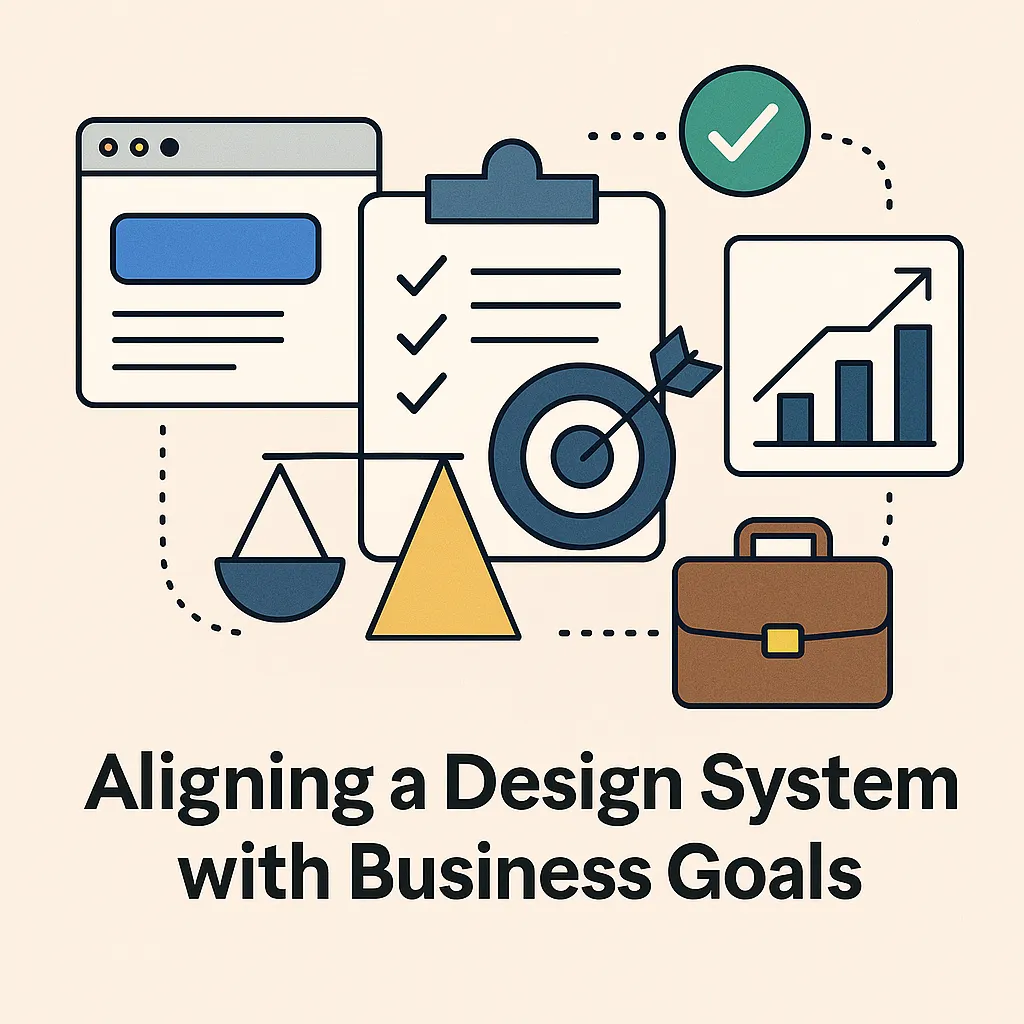
A Design System is more than just buttons, colors, and code snippets. It’s a product that should move the needle on what matters most to your company: efficiency, scalability, customer satisfaction, and digital transformation.
Why Alignment Matters
Let’s face it — building a Design System is resource-intensive. You’re not just making components in Figma or shipping a library of Angular/React modules; you’re changing how teams design, build, and ship digital products.
Without clear alignment to business goals:
- Teams won’t see the value in adopting it.
- Leadership won’t prioritize it.
- The Design System will struggle to justify its ROI.
Step 1: Start with the Business Strategy
Before diving into pixels and tokens, ask:
- What are the company’s top priorities this year? Is the focus on improving customer experience? Expanding into new markets? Cutting costs through efficiency?
For example, if a company’s strategy is to speed up digital transformation across 50+ products, then the Design System should deliver faster implementation, scalable patterns, and governance that helps distributed teams work together.
Step 2: Translate Goals into System Objectives
Here’s where the magic happens. Take those high-level goals and translate them into Design System objectives.
- Business Goal: Reduce time-to-market for new digital products.
- DS Objective: Provide ready-to-use component libraries in Figma and code, so teams don’t reinvent the wheel.
- Business Goal: Strengthen brand consistency across channels.
- DS Objective: Centralize visual foundations (colors, typography, spacing) and enforce brand governance through shared libraries.
- Business Goal: Improve accessibility and compliance.
- DS Objective: Bake accessibility standards into every component, reducing the risk of non-compliant interfaces.
Step 3: Measure What Matters
It’s not enough to ship components — you need to prove impact. Metrics should link directly to business outcomes. Examples:
- Component adoption rate → tied to efficiency.
- Reduction in design/development cycle time → tied to speed-to-market.
- Decrease in UX inconsistencies or accessibility issues → tied to customer satisfaction and compliance.
Step 4: Communicate in Business Language
When presenting the Design System to executives, avoid jargon like “semantic tokens” or “variant properties.” Instead, talk about:
- Cost savings from reducing duplicate work.
- Risk reduction from ensuring accessibility and compliance.
- Scalability to support new products and markets faster.
This is how you move from being “the design team’s project” to becoming a strategic enabler of the company’s vision.
The Practical Checklist
Before kicking off — or recalibrating — your Design System, ask yourself these five questions:
- What are the top three business goals this year?
(Growth, efficiency, brand consistency, customer experience, compliance, etc.) - Which of these can the Design System directly influence?
(Don’t try to solve everything — focus where you can drive impact.) - How do I translate these into measurable DS objectives?
(E.g., “reduce design cycles by 30%” or “100% accessibility compliance in all components.”) - What metrics will prove the DS is working?
(Adoption rates, time saved, reduced inconsistencies, NPS, etc.) - How will I communicate the value to executives and teams?
(Use business language, not design jargon.)
Conclusion
A Design System that lives only in the realm of designers and developers will never reach its full potential. But a Design System that is aligned with business goals becomes an engine for transformation — delivering speed, consistency, and customer experiences that matter.
If you’re starting or scaling a Design System, pause and ask: How does this connect to what the business needs most? The answer will define the difference between another unused toolkit and a system that drives real impact.